Table of Contents
ToggleA cramped entryway doesn’t have to feel like an afterthought. Whether you’re working with a narrow hallway in an older home or a three-foot-wide landing in a modern apartment, the right combination of furniture, storage, and visual strategy can turn a tight squeeze into a functional drop zone that actually looks good. The trick isn’t adding more, it’s choosing smarter. From wall-mounted solutions that keep floor space clear to furniture pieces that pull double duty, small entryway design is about editing ruthlessly and building vertically. This guide walks through proven layout strategies, specific product types, and visual techniques that make compact entryways work harder without feeling cluttered.
Key Takeaways
- Small entryway ideas work best by prioritizing vertical storage and wall-mounted solutions over freestanding furniture that consumes valuable floor space.
- Strategic use of mirrors, light-neutral paint, and vertical design elements visually expands compact entryways and prevents them from feeling cramped.
- Multi-functional furniture like narrow consoles (10–12 inches deep), storage benches, and fold-down seats maximize both usability and style in apartment entryway designs.
- Assign dedicated storage spots for specific items—shoes, coats, keys, mail—using pegboards, slim shoe cabinets, and wall-mounted hooks to prevent clutter from spreading throughout your home.
- Layer task and ambient lighting with overhead fixtures and plug-in sconces to brighten dim entryways and improve both safety and welcome.
- Balance personalization with restraint by anchoring the space with one statement piece and rotating seasonal decor to maintain freshness without overcrowding.
Why Your Small Entryway Deserves Strategic Design
Most homeowners treat small entryways like transitional dead zones, a place to kick off shoes and toss keys before moving into the “real” living space. But that narrow strip of floor between the front door and your main rooms sets the tone for the entire home. It’s also the first place clutter accumulates if there’s no plan to contain it.
A well-designed small entryway solves three problems at once: storage (coats, bags, shoes), organization (keys, mail, dog leashes), and aesthetics (guests’ first impression). The goal isn’t to replicate a grand foyer, it’s to build a lean system that handles daily traffic without sprawl.
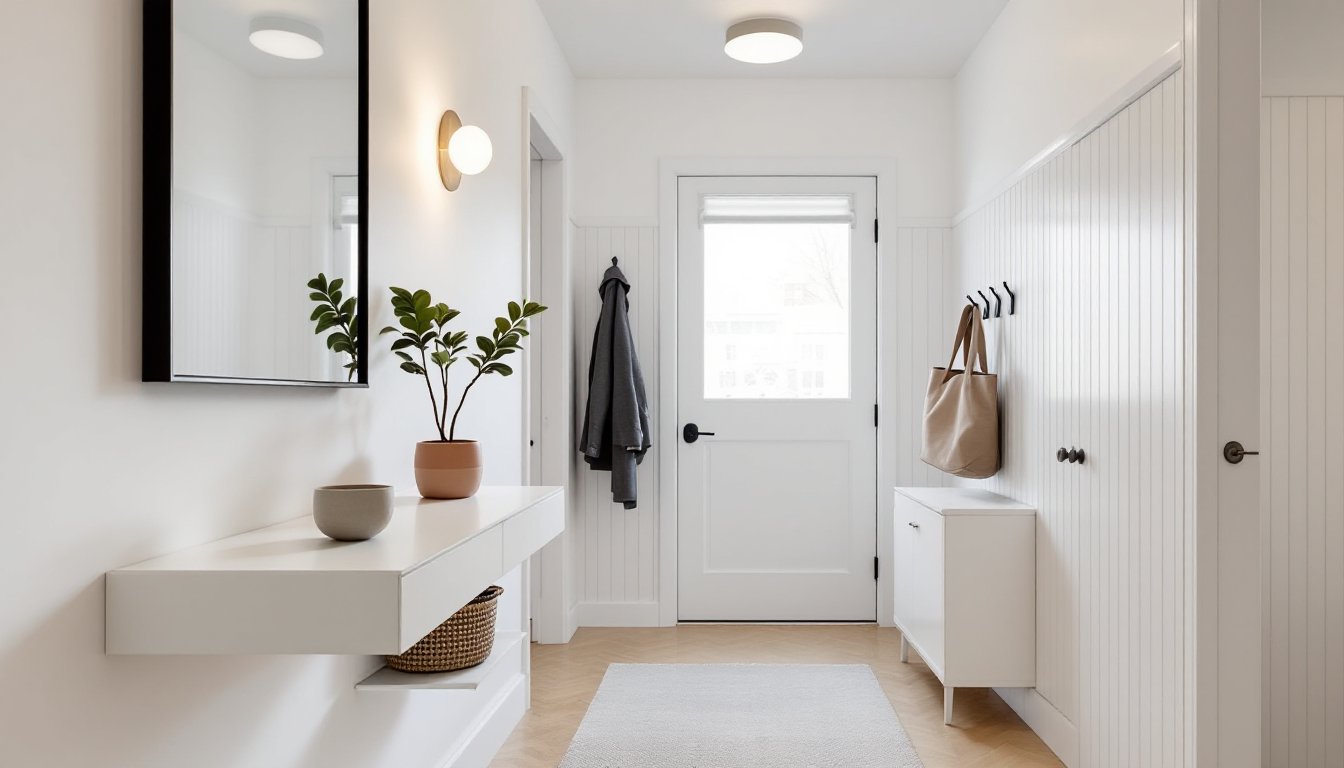
In small modern entryway ideas, every vertical inch counts. Standard entryways range from 36 to 48 inches wide in most single-family homes, and even narrower in older walk-ups or condos. That means floor space is at a premium. Successful layouts prioritize wall-mounted and vertical storage over freestanding furniture that eats up square footage. Think hooks instead of coat trees, narrow consoles instead of benches with bulk, and mirrors that reflect light instead of art that just fills a gap.
If the entryway opens directly into the living room with no defined boundary (common in apartments), use a runner rug or a low console to create a visual threshold. This delineates the “entry zone” and keeps the clutter contained to one deliberate area rather than bleeding into the main living space.
Smart Storage Solutions That Don’t Sacrifice Style
Storage in a small apartment entryway has to be aggressive and efficient. There’s no room for decorative pieces that don’t earn their keep. Start by inventorying what actually needs to live in the entryway: coats, shoes, bags, keys, mail, umbrellas. Then assign each category a dedicated spot.
Shoe storage is the biggest space hog. A standard over-the-door shoe organizer works if there’s a coat closet, but in very small entryway ideas where there’s no closet at all, consider a slim shoe cabinet with a depth of 6 to 8 inches. These tip-out models (sometimes called “shoe drawers”) mount flush to the wall and hold 12 to 18 pairs in a footprint that’s narrower than a standard baseboard. Brands like IKEA’s Hemnes or similar knock-down units fit this profile.
For bags and everyday carry, a pegboard wall system offers modular flexibility. Mount a 24-by-48-inch pegboard panel to studs using ¼-inch spacers (critical, the spacers allow pegs to insert from the front). Spray paint it to match the wall color, then add hooks, small shelves, and bins as needed. Pegboard accommodates changes in what you carry seasonally (sunglasses in summer, hats in winter) without requiring new hardware.
Mail and key trays prevent counter creep. A wall-mounted mail sorter with keyring hooks keeps paper from piling up on any horizontal surface. If there’s a narrow console (10 to 12 inches deep), a shallow tray or small catch-all bowl works, but it has to be small enough that it can’t accumulate junk. Bigger trays become junk magnets.
Wall-Mounted Hooks and Floating Shelves
Hooks are the backbone of small entryway decor ideas. Heavy-duty coat hooks rated for 15 to 20 pounds each should be screwed directly into studs or anchored with toggle bolts in drywall. Space them 6 to 8 inches apart horizontally to prevent coat overlap. Mount them at 60 to 65 inches from the floor for adult use, or add a second row at 40 inches if kids use the space.
Floating shelves above the hook line (around 72 inches up) provide a home for hats, small bins, or decorative objects that don’t interfere with the functional zone below. Use ¾-inch plywood or solid wood shelves at least 8 inches deep, mounted on heavy-duty floating shelf brackets rated for the span. A 36-inch shelf needs brackets every 16 inches (at stud spacing) to prevent sag. Sand, prime, and paint or stain the shelf to match trim or cabinetry for a built-in look.
Furniture That Works Double Duty
In apartment entryway ideas, multifunctional furniture isn’t optional, it’s the only way to fit a full drop zone into a few square feet. The best pieces combine seating, storage, and surface area without taking up more than 12 to 18 inches of floor depth.
Narrow console tables (10 to 12 inches deep) offer a surface for keys and mail without blocking foot traffic. Look for models with a lower shelf or drawer. A single drawer is enough to stash sunglasses, dog leashes, and small items that would otherwise clutter the tabletop. If the entryway is only 36 inches wide, a half-moon or corner console maximizes surface area while hugging the wall.
Storage benches with lift-up seats are ideal if there’s room for a 16-to-18-inch depth. These provide a place to sit while putting on shoes, plus hidden storage for scarves, gloves, or seasonal items. Many also include cubby-style shoe storage below the seat. Make sure the bench height is 18 inches, the standard seat height that’s comfortable for most adults.
For very small apartment entryway ideas where even a bench is too bulky, a wall-mounted fold-down seat (like a shower bench) can be installed on a hinge. It flips up flat against the wall when not in use. Mount it to studs and use a piano hinge or heavy-duty folding bracket rated for at least 250 pounds.
Another smart pick is a hall tree with a built-in bench and hooks, but only if the ceiling height allows it. Standard hall trees run 72 to 78 inches tall and work best in entryways with 8-foot ceilings or higher. In spaces with lower ceilings or bulkheads, they can feel oppressive.
If the entryway doubles as a mini mudroom (common in homes without a side or back entry), add a boot tray underneath the bench or console. A plastic or metal tray with a lip catches snow, mud, and water, protecting floors. Dump and rinse it weekly during wet seasons.
Visual Tricks to Make Your Entryway Feel Larger
Small entryway ideas modern often lean on visual expansion techniques to offset tight square footage. Paint, mirrors, and sightlines all influence how spacious (or cramped) a small entry feels.
Mirrors are the most effective spatial tool. A large mirror (at least 24 by 36 inches) mounted on the wall opposite or adjacent to the entry door reflects light and visually doubles the apparent depth of the space. In narrow hallways, a full-length leaner mirror propped against the wall can make the corridor feel taller. Secure the top of leaner mirrors to the wall with furniture straps or L-brackets to prevent tipping.
Paint color matters more in small spaces. Light, neutral tones (whites, soft grays, warm beiges) reflect more light and recede visually, making walls feel farther apart. Semi-gloss or satin finishes bounce more light than flat paint, which can help in dim entryways. If you want color, save it for an accent wall or the inside of a coat closet, don’t wrap a dark shade around all four walls of a tight entry.
Vertical lines draw the eye up, making ceilings feel higher. Use board-and-batten wainscoting, tall narrow artwork, or floor-to-ceiling hooks to emphasize height over width. According to design resources like Apartment Therapy, vertical design elements help compact spaces feel less boxy.
Keep the floor clear and unbroken. A single runner rug that spans the length of the entryway creates a continuous visual line. Avoid multiple small rugs or mats that chop the space into segments. Choose a rug width that leaves 4 to 6 inches of floor visible on each side, this framing effect prevents the rug from looking crammed in.
If there’s a door at the end of the entryway (leading to a closet or another room), paint it the same color as the walls. This “camouflages” the door and prevents the eye from stopping short, making the hallway feel longer.
Lighting and Color Choices for Compact Entryways
Many small entryways lack natural light, especially in apartments or homes where the front door opens into an interior hallway. Poor lighting makes a small space feel even smaller, and it’s a safety issue if you can’t see to unlock the door or navigate stairs.
Overhead lighting is non-negotiable. If there’s no existing ceiling fixture, hire an electrician to install one. A flush-mount or semi-flush ceiling light with a diffused glass shade spreads light evenly without glare. Choose a fixture with a diameter that’s roughly one-third the width of the entryway (e.g., a 12-inch fixture for a 36-inch-wide hall). LED bulbs in the 2700K to 3000K range (warm white) feel welcoming without the institutional coldness of daylight-temp bulbs.
If running new electrical isn’t in the budget, battery-powered LED puck lights or plug-in sconces can fill the gap. Modern plug-in sconces come with fabric cords and decorative wall plates that look intentional, not makeshift. Mount them 60 to 66 inches from the floor, flanking a mirror or piece of art.
Task lighting helps with specific activities. A small table lamp on a console adds ambient light and creates a homey glow when you walk in after dark. If there’s no surface space, a swing-arm wall lamp mounted next to the door works well. Popular DIY blogs like Young House Love often feature simple sconce installations that add both function and character.
For color choices, avoid high-contrast schemes in very small spaces. A bright white ceiling with dark walls can make the ceiling feel lower. Instead, use a monochromatic palette where walls, trim, and ceiling are within two shades of each other. This blurs boundaries and makes the space feel more open.
Accent lighting can highlight artwork or architectural details, but keep it minimal. A single picture light or a small LED strip under a floating shelf adds interest without clutter. Too many light sources in a small area create visual noise.
Personalizing Your Space Without Overcrowding
Small modern entryway ideas often walk a fine line between “welcoming” and “cluttered.” Personal touches matter, but in a compact footprint, every decorative item has to justify its presence.
Start with one statement piece. This could be a bold runner rug, an oversized mirror in an interesting frame, or a piece of art that reflects your style. Let that anchor the space, then build around it with restraint. In design inspiration from sources like Homedit, less is consistently more in small-space styling.
Artwork works best when it’s scaled appropriately. A single large print (16 by 20 inches or bigger) has more impact than a gallery wall of small frames, which can feel busy. Hang art at 57 to 60 inches on center (the middle of the piece at average eye level). If the entryway has low ceilings, keep art closer to 54 inches to avoid a top-heavy look.
Plants add life but need to be functional. A tall, narrow plant like a snake plant or a small fiddle leaf fig in a floor planter can fill a corner without sprawl. Wall-mounted planters or a single trailing pothos on a floating shelf work in tighter spaces. Avoid wide, bushy plants that jut into the walkway.
Personal items, photos, small collections, seasonal decor, should rotate. Swap out a few pieces every few months to keep the space feeling fresh without permanent clutter. Use a small tray or shadow box to corral these items so they don’t spread.
Finally, resist the urge to fill every surface. Negative space (empty wall, clear tabletop) gives the eye a place to rest and prevents the entryway from feeling like a packed storage closet. If a shelf or console looks bare with just keys and a plant, that’s okay, it means there’s room to breathe.