Table of Contents
ToggleBuilding a mouse trap car is one of those projects that looks deceptively simple until you’re staring at a pile of wheels, dowels, and a spring-loaded trap wondering how it all comes together. Whether it’s for a school physics assignment, a weekend project with the kids, or just because you’re curious about converting potential energy into kinetic motion, this build teaches real engineering principles without requiring a machine shop. The concept is straightforward: a wound-up mouse trap releases stored energy, pulls a string attached to an axle, and propels the car forward. Execution, though, requires some planning. This guide walks through the entire build process, from selecting materials to fine-tuning your design for maximum distance.
Key Takeaways
- A mouse trap car converts stored spring energy into kinetic motion by releasing a wound-up trap that pulls a string attached to the rear axle, demonstrating pure physics principles for school projects or DIY enthusiasts.
- Selecting the right materials—Victor-style wooden traps, balsa wood chassis, appropriately sized wheels (CDs for distance, smaller wheels for speed), and fishing line—directly impacts your mouse trap car’s performance and distance capability.
- Large rear wheels (4-5 inches diameter) paired with small front wheels maximize distance, while friction reduction through smooth axles, plastic tubing bearings, and weight elimination are critical optimization strategies.
- Precise axle alignment, controlled lever arm length (1.5 to 2 times the trap-to-axle distance), and neat single-layer string wrapping prevent energy loss and dramatically improve acceleration and distance.
- Test incrementally with one modification at a time—adjusting wheel size, lever length, or weight reduction—to identify which changes actually improve performance rather than changing everything at once.
- Common pitfalls like misaligned axles, over-gluing, improper string placement, and inadequate trap securing can severely hamper your design, so prioritize precision in assembly and always wear safety glasses during testing.
What Is a Mouse Trap Car and How Does It Work?
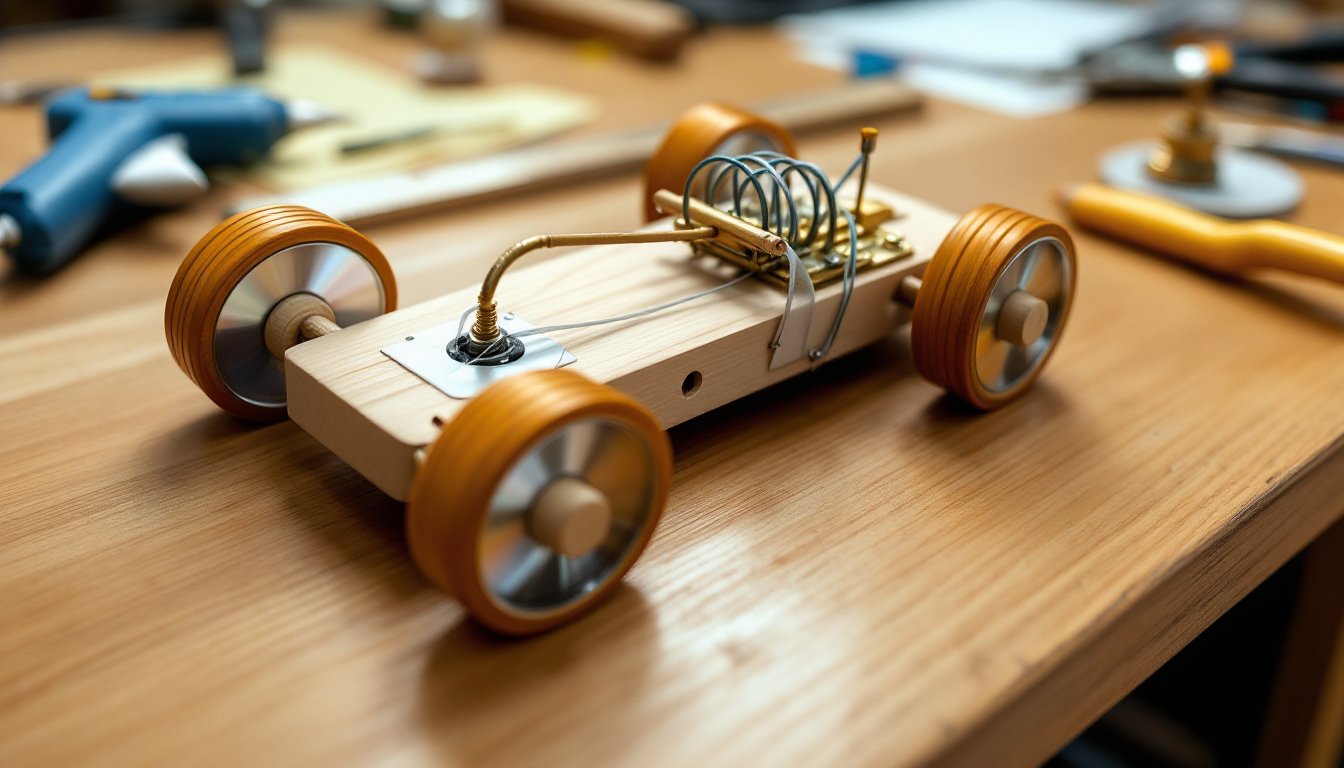
A mouse trap car is a small vehicle powered entirely by the energy stored in a loaded mouse trap spring. When the trap’s arm is released, it rotates and winds up a string attached to the rear axle, converting the trap’s potential energy into rotational motion that drives the wheels.
The mechanics are pure physics. The mouse trap’s torsion spring stores energy when cocked. As it snaps shut, that energy transfers through a lever arm (the snap bar) to a string wound around the axle. The longer the lever arm, the more distance the string can travel, which translates to more axle rotations and greater overall distance. Think of it as a miniature wind-up toy, except you’re the engineer deciding gear ratios, wheel diameter, and friction points.
Mouse trap cars compete on different metrics depending on the goal. Some creative home improvement ideas involve building for maximum distance, where lightweight construction and large rear wheels dominate. Others focus on speed, requiring smaller wheels and shorter lever arms for faster acceleration. Understanding which type you’re building shapes every material choice.
The beauty of this project is its scalability. A basic model uses household items and takes an afternoon. Advanced mouse trap car designs incorporate precision-cut wood, ball bearings, and CDs for wheels, pushing distances beyond 100 feet. Either way, the core principle remains the same: mechanical energy transfer with minimal friction loss.
Essential Materials and Tools You’ll Need
Start with a standard Victor-style wooden mouse trap, the classic rectangular design with a metal snap bar. Avoid plastic traps: they lack the spring tension needed for reliable performance. You’ll also need a chassis material. Balsa wood or basswood strips work well for lightweight builds. For something sturdier, use 1/8-inch thick plywood cut to about 10-12 inches long and 3-4 inches wide.
Axle materials depend on your precision level. Wooden dowels (3/16-inch or 1/4-inch diameter) are easy to work with and available at any craft store. Metal rods (coat hangers straightened out work in a pinch) reduce flex but require drilling precise holes. For wheels, options include:
- CDs or DVDs (lightweight, large diameter for distance builds)
- Wooden wheels from craft stores (better grip, adjustable sizes)
- Plastic bottle caps (quick solution for speed builds)
- Foam board circles cut with a compass cutter
You’ll need fishing line or thread for the pull string, something strong but thin. Monofilament fishing line (10-15 lb test) works best because it doesn’t stretch. For attaching wheels to axles, pick up hot glue, super glue, or electrical tape. Eye hooks or small screw eyes anchor the string to the mouse trap arm.
Tools required:
- Drill with bits matching your axle diameter
- Utility knife or hobby saw for cutting wood
- Hot glue gun
- Needle-nose pliers (for bending wire and adjusting the trap)
- Ruler and pencil
- Sandpaper (120-grit)
Safety note: Wear safety glasses when cutting materials and testing the trap mechanism. A loaded mouse trap snapping unexpectedly can cause finger injuries or send small parts flying.
Step-by-Step Instructions for Building Your Mouse Trap Car
This build assumes a distance-focused design with CD wheels and a wooden chassis. Adjust measurements based on available materials.
Assembling the Base and Axles
Cut your chassis to size, 10 inches long by 3 inches wide is a good starting point. Mark axle positions: one set about 1 inch from the front edge, another 1 inch from the rear. The rear axle will be the drive axle attached to the mouse trap.
Drill holes for the axles perpendicular to the chassis, keeping them as straight as possible. Misaligned holes cause wobble and friction. For 3/16-inch dowels, use a 13/64-inch bit: you want a snug fit but not so tight the axle binds. Test-fit the dowels, they should rotate freely without excessive side-to-side play.
Cut axles to length. Front and rear axles should extend about 1/2 inch beyond each side of the chassis to accommodate wheels. Sand the ends smooth. Many step-by-step DIY tutorials recommend wrapping a few turns of masking tape around the axle where it passes through the chassis to reduce friction against the wood, it works better than you’d expect.
Attach wheels to the axles using hot glue. For CDs, apply a bead of hot glue around the axle end, press the CD on, and hold for 30 seconds. Make sure wheels are perpendicular to the axle: angled wheels create drag and cause the car to veer. Check alignment by rolling the car on a flat surface, it should track straight.
Distance builds: Use large rear wheels (CDs work great) and smaller front wheels to reduce rotational inertia. Speed builds: Keep all four wheels smaller and roughly equal in diameter.
Attaching the Mouse Trap and Creating the Pull String
Remove the bait holder and latch bar from the mouse trap, you only need the base, spring, and snap bar. Position the trap on the chassis with the snap bar facing the rear axle. The trap should sit close enough that the extended snap bar nearly touches the rear axle when released. Secure it with hot glue or zip ties. Hot glue is faster: zip ties allow adjustments.
Extend the snap bar’s reach by taping or gluing a wooden skewer, popsicle stick, or lightweight dowel to it. This lever arm is critical: longer arms mean more string travel and greater distance, but also slower acceleration. Start with an extension that reaches 2-3 inches beyond the rear axle when the trap is set.
Drill a small hole or insert a screw eye into the end of the lever arm extension. This is where the pull string attaches. Cut a length of fishing line, about 3-4 feet is plenty for initial tests. Tie one end to the screw eye on the lever arm.
Wrap the other end of the string around the rear axle 3-4 times, then secure it with a small piece of tape. The string should wind onto the axle as the lever arm rotates. When you set the mouse trap (carefully), the lever arm should be pulled back, creating tension in the string.
Test the mechanism by gently releasing the trap. The lever arm should snap forward, pulling the string and rotating the rear axle. If the string slips, add a small groove or notch in the axle with sandpaper, or use a thin layer of hot glue to create grip.
Adjustment tip: The string length matters. Too short, and the lever arm stops before fully releasing its energy. Too long, and the string bunches up or drags. Experiment with winding more or fewer loops around the axle.
Design Tips to Maximize Distance and Performance
Distance is a function of energy efficiency. Every ounce of weight, every rough axle hole, every misaligned wheel bleeds energy. Start by reducing mass. Drill holes in non-structural parts of the chassis (like the middle section away from the axles). Trim excess wood. Some competitive mouse trap car ideas use carbon fiber rods or hollowed-out balsa, but even basic weight reduction helps.
Wheel size dramatically affects performance. Large rear wheels increase the distance traveled per axle rotation, think of it as a longer stride. For maximum distance, use wheels 4-5 inches in diameter on the rear. Keep front wheels small (1-2 inches) since they’re just along for the ride and you want minimal rotational inertia.
Friction is the enemy. Upgrade axle holes by lining them with short pieces of plastic drinking straw or brass tubing. This creates a smoother bearing surface than raw wood. Ball bearings make a noticeable difference if you’re willing to invest the time, press them into wheels or mount them in the chassis for near-frictionless rotation.
The lever arm length requires balance. Longer arms increase string travel (more rotations, more distance) but reduce mechanical advantage (slower acceleration). A good starting point is 1.5 to 2 times the distance from the trap pivot to the rear axle. Fine-tune by testing: if the car barely moves, the arm may be too long: if it accelerates quickly but stops early, try lengthening it.
Traction matters, especially on smooth surfaces. Adding rubber bands around CD wheels or using wheels with textured surfaces prevents slippage. Some builders wrap the drive wheels with electrical tape or apply a thin layer of hot glue for grip.
Aerodynamics play a minor role at these speeds, but keeping the profile low and avoiding sail-like extensions helps. Think sleek, not tall. Testing different designs is part of the fun, hands-on DIY tutorials often show wildly different approaches that all work for specific goals.
Common Mistakes to Avoid When Building Your Car
The most frequent error is misaligned axles. Even a slight angle causes wheels to scrub against the chassis or point in different directions, killing momentum. Take your time drilling holes and use a drill press if available. If drilling by hand, use a square to keep the bit perpendicular.
Over-gluing adds unnecessary weight and creates hard, uneven surfaces. Use just enough adhesive to secure parts. A single drop of super glue often beats a glob of hot glue.
Many first-time builders ignore string placement. If the string wraps unevenly on the axle or crosses itself, it binds and wastes energy. Wind it neatly in a single layer. Some designs use a spool or tape a narrow tube to the axle to guide the string.
Testing on the wrong surface skews results. Carpet adds too much friction: a polished floor might lack traction. Test on a smooth, clean surface like a gymnasium floor or a long hallway with tile or sealed concrete.
Another mistake is not securing the mouse trap firmly. If it shifts during release, energy goes into moving the trap instead of the wheels. Use multiple attachment points or reinforce with zip ties.
Safety reminder: Always keep fingers clear of the snap bar when setting the trap. Wear safety glasses during test runs in case a wheel flies off or the string snaps. It’s a small project, but a loaded mouse trap has enough force to hurt.
Finally, don’t skip incremental testing. Build the basic car, test it, then make one change at a time (wheel size, lever length, weight reduction). If you change everything at once, you won’t know which modification helped or hurt performance. Document what works, future mouse trap car designs benefit from those notes.